ARTICLE SUMMARY:
Companies can leverage Predetermined Change Control Plans to iterate their products over time without frequent trips back to FDA. FDA initially unveiled PCCPs as a tool to address AI algorithm updates, but the approach is also being used to pre-authorize other change types, including adding compatible devices, updating product design, refining manufacturing, and even expanding the labeled patient population. Market Pathways crunches the numbers and offers examples of how PCCPs are employed.
Predetermined Change Control Plans (PCCPs) have surfaced over the past five years as a compelling new regulatory tool to help companies and FDA manage device modifications more predictably and efficiently. The mechanism has received most attention as a strategy for addressing AI-enabled devices, which by nature are subject to rapid iterations over time that are difficult to manage by submitting 510(k)s or PMA supplements for every modification.
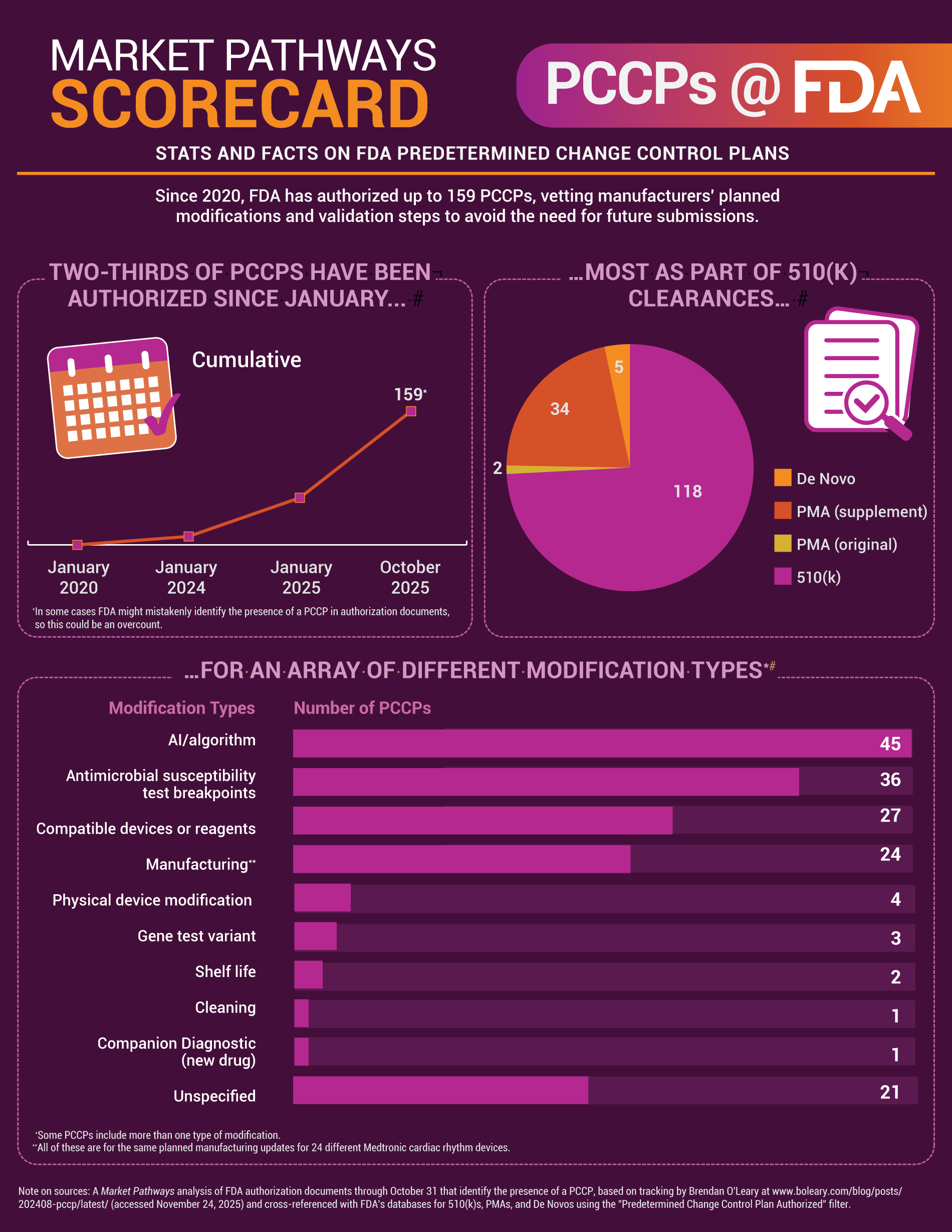
But FDA (with support from Congress) has made clear that PCCPs—allowing FDA to sign off in advance on a manufacturer’s planned future device modifications—have broader application beyond just AI in the medical device sphere, and that has translated into real practice. An analysis by Market Pathways of the up to 159 total PCCPs that have been authorized by the agency through the end of October shows that while AI algorithm-related refinements appear to be the most common types of modification addressed by change control plans, there are an array of other use cases the agency has signed off on (see “Market Pathways Scorecard: PCCPs @ FDA” – click image to enlarge – and “Note on Data,” below).