
ARTICLE SUMMARY:
Most joint reconstruction surgeons support the use of orthopedic robots to improve precision and short-term patient outcomes in knee reconstruction surgeries. Excerpted from MedTech Strategist’s recent article, “Total Joint Arthroplasty and Robotics in 2022: An Update.”
The pandemic hasn’t dampened the well-acknowledged popularity of Stryker Corp.’s MAKO Robotic System, which has contributed significantly to the company’s overall growth in total recon market share. 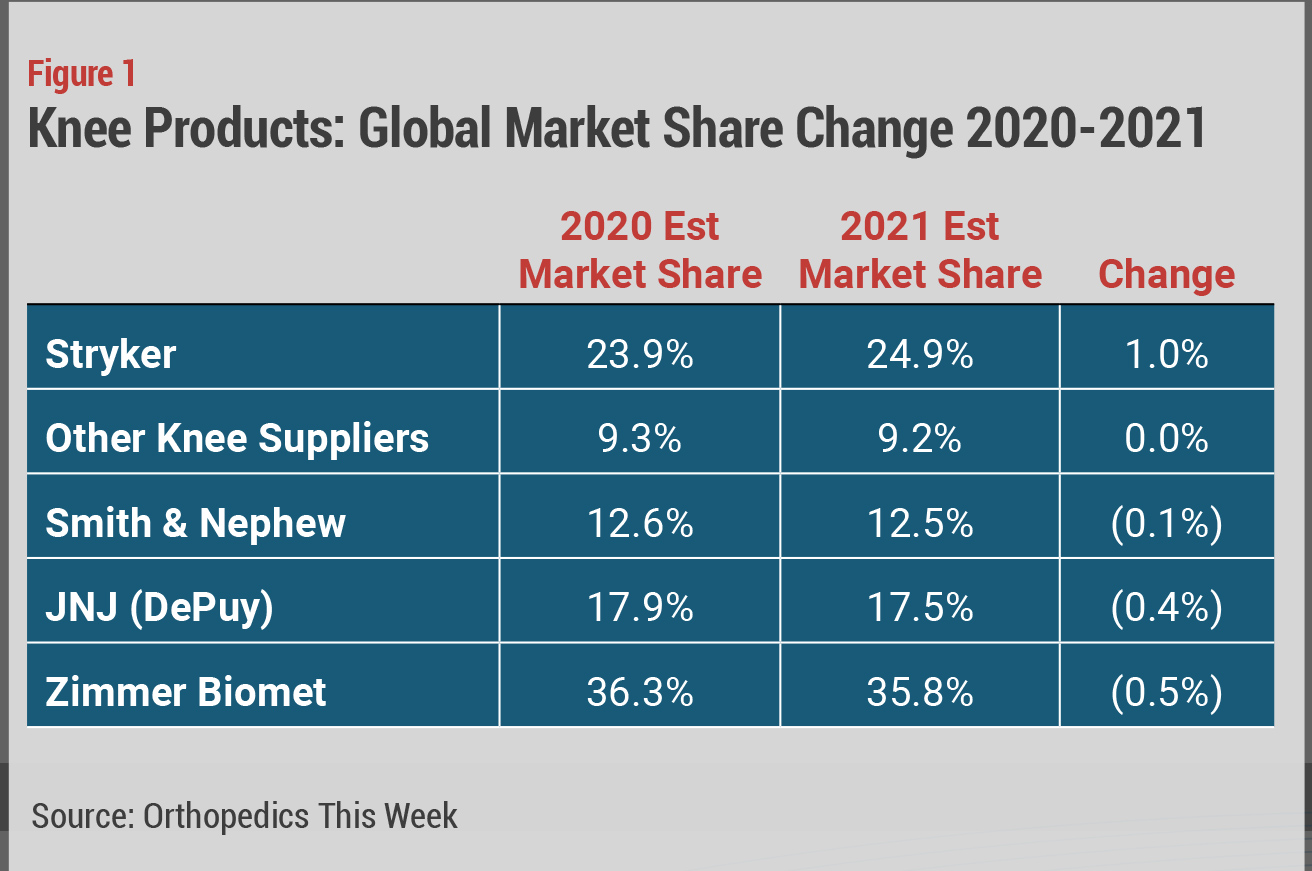 MAKO has about a 70% share of the 1,700 total installed orthopedics robots in the US, and 25% of all total knee arthroplasty (TKA) procedures in the US are currently robotic, according to Wells Fargo. Stryker’s knee business grew nearly 20% year on year from 2020 to 2021 in an overall market that grew 14.9%, according to Orthopedics This Week (an outlier year due to pandemic irregularities), but even more telling, its share of the knee market grew 1%, while other leading suppliers—Zimmer Biomet, Smith & Nephew PLC, and Johnson & Johnson—saw their shares decline slightly (0.5%, 0.1% and 0.4%, respectively). These occurred in a market that is essentially forecast to grow in the low single digits for the foreseeable future (See Figure 1).
Stryker’s President of Digital, Robotics, and Enabling Technologies Robert Cohen told investors in February that more than 50% of Stryker knee surgeries during fourth-quarter 2021 used MAKO robotics. In investor meetings earlier this year, J&J executives projected that robotic surgery penetration in TKA in general will grow from 10% to 30% in the next few years, bolstered by patient engagement, physician efficiencies, and improved outcomes.
For now, analysts say, given the low market penetration for orthopedic robotics, room exists for multiple players, and Stryker’s competitors are positioned to also make inroads based on differentiation.
 Trial MyStrategist.com and unlock 7-days of exclusive subscriber-only access to the medical device industry's most trusted strategic publications: MedTech Strategist & Market Pathways. For more information on our demographics and current readership click here.