
ARTICLE SUMMARY:
Next-gen start-ups treat heart failure tap into physiological mechanisms to help patients. Excerpted from our recent feature article.
Heart failure still represents one of the greatest unmet needs in medicine. The lifetime risk of this degenerative and life-threatening disease has risen to almost one in four, and the prevalence is rapidly rising. In 2022, it was a contributing cause of almost half of all cardiovascular deaths, and within two decades, the costs of managing this challenging condition are projected to reach $858 billion, with 50% of that sum due to frequent episodes of hospitalization.
Long seen by therapy innovators as primarily a problem of the heart’s pumping—mechanical and electrical dysfunctions that could be fixed in isolation—today’s heart failure innovators understand it as a systemic condition: a complex interplay between the heart, lungs, kidneys, lymphatic system, and vasculature, where each component can amplify—or worsen—the others in a doom loop.
Medical device strategics are showing keen interest in this space, evidenced by recent acquisitions such as Johnson & Johnson’s purchase of V-Wave, the developer of a minimally invasive interatrial shunt for heart failure patients who experience elevated left atrial pressure, in a deal worth $1.1 billion when up-front and commercial payments are added up.
This degenerative disease often starts long before patients are aware of symptoms, yet once structural changes happen, cardiorenal and cardiopulmonary systems go out of whack, further intensifying the disease progression. For that reason, one of the major clinical goals today is catching early signs of the disease, and for those patients already in the loop, detecting signals of deterioration before they find themselves in a full-blown episode of acute decompensated heart failure (ADHF) requiring hospitalization.
Today’s heart failure innovators understand it as a systemic condition: a complex interplay between the heart, lungs, kidneys, lymphatic system, and vasculature, where each component can amplify—or worsen—the others in a doom loop.
In this space, we’ve discussed Acorai before; the start-up is in the business of detecting these early signs of deterioration noninvasively. Acorai has raised about $24 million to date for its FDA-designated Breakthrough Device. Having validated its noninvasive approach as compared to the gold standard (invasive right heart catheterization) in the 1,600 patient clinical study CAPTURE, Acorai is now conducting a 1,000 patient pivotal study aiming to demonstrate the health economics benefits of its scalable tool.
Ventric Health aims to bring an early heart failure screen to primary care, the setting of the physicians most likely to see patients when they’re in the earliest stages of disease. The company’s FDA-cleared noninvasive device works to detect both HFrEF (heart failure with reduced ejection fraction, or a dysfunction of pumping) and HFpEF (heart failure with preserved ejection fraction, a dysfunction of heart filling).
Indeed, the ability to address both heart failure patient populations is a feature of many of the next-generation heart failure companies. Not long ago, HFpEF was left behind in terms of effective diagnostics and treatment options, but the advent of new and effective pharmaceuticals for this group of patients, such as the class of SGLT2 inhibitors, creates an imperative to find and treat them early.
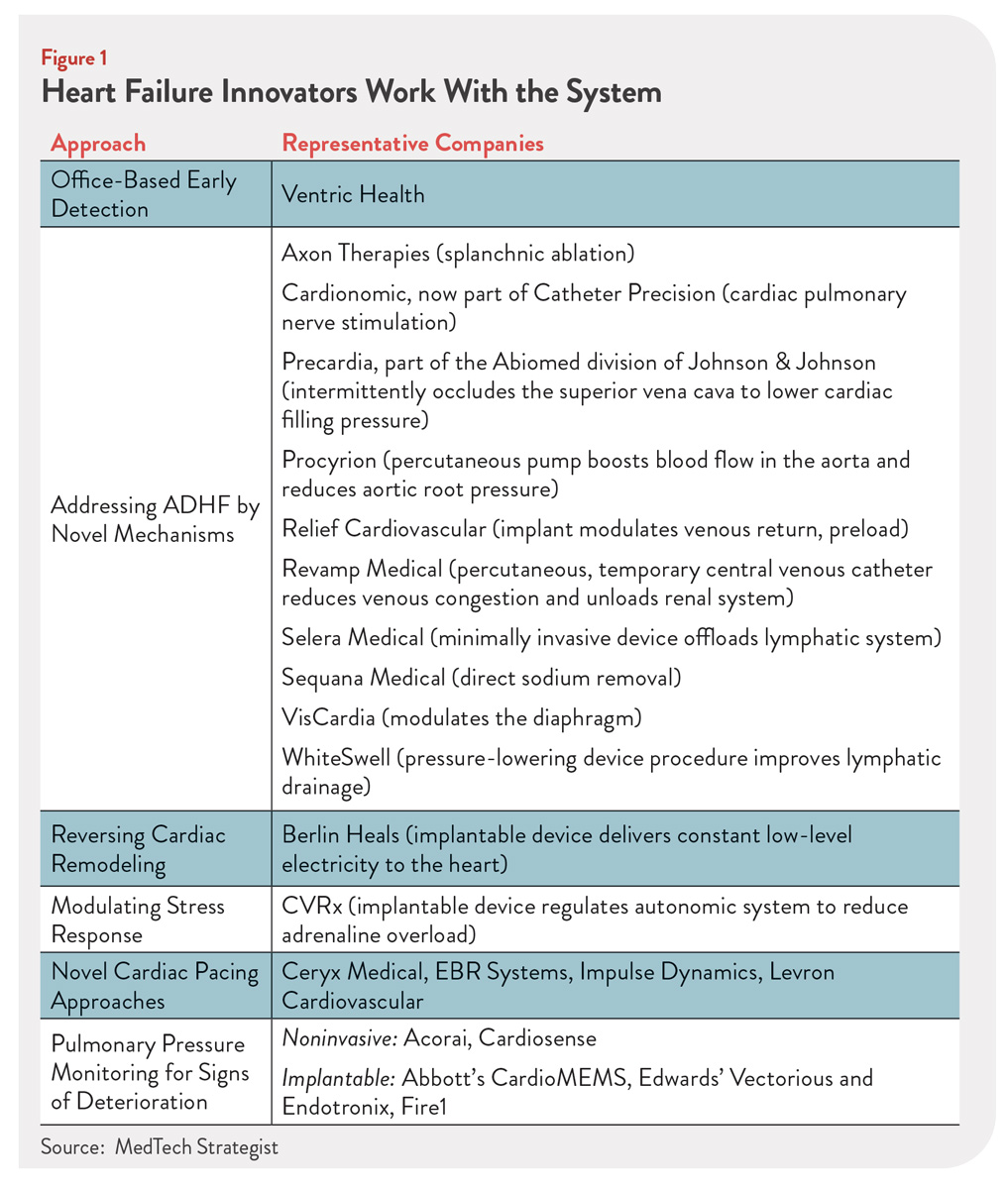 Many companies have clustered around the goal of improving the treatment of ADHF, one, because it’s responsible for the costly hospitalizations noted above, and two, because each episode worsens a patient’s heart failure (see Figure 1). Thus, an important goal is to detect exacerbations early enough to prevent such hospitalizations.
Aligned with that theme were the Edwards Lifesciences acquisitions of Endotronix and Vectorious Medical. The structural heart leader acquired Endotronix, maker of the Cordella implantable pulmonary artery pressure sensor, in July 2024, and Vectorious, which developed the V-LAP implantable left atrial pressure sensor, in September 2025, in a transaction that valued the start-up at almost $500 million. These tools allow clinicians to catch episodes of ADHF early and proactively manage patients.
Indeed, the ability to address both types of heart failure—HFrEF and HFpEF—is a feature of many of the next-generation heart failure companies.
What’s particularly interesting about next-generation start-ups is their focus on intervening not directly on the heart itself, but along the physiological pathways that contribute to ADHF, and by working with or repairing innate mechanisms along the entire interconnected system involved in cardiac health. We present two such examples.
WhiteSwell takes advantage of the large fluid-removing capacity of the lymphatic system to quickly and safely move ADHF patients to a healthier state. Its efficacy will lean on not just fluid removal itself, but also the way in which that engages the kidneys to work better for a long-lasting result.
Levron Cardiovascular has a novel pacing approach to help the heart by coordinating breathing cycles with pumping cycles
Taken together, these emerging technologies reflect a broader shift in how innovators think about heart failure—not as a single organ failure, but as a breakdown of the body’s integrated fluid and pressure management systems. By sensing earlier, intervening along physiological pathways, and restoring the natural mechanisms that regulate circulation, breathing, and fluid balance, innovations of next-generation companies are reframing the therapeutic playbook. If successful, this systems-level approach could not only reduce costly hospitalizations for acute decompensated heart failure, but it could also slow the disease’s relentless progression—bringing heart failure care closer to prevention and long-term stability rather than repeated rescue.
Continue reading Innovating Heart Failure: Start-Ups Harness Natural Pathways here.