
ARTICLE SUMMARY:
Orthopedics companies, weighed down by depressed stock prices and market challenges, are under intense pressure to step out of their comfort zones and make bets on innovation that will drive their future. Wall Street analysts are growing more positive on the sector, and PE investors and strategics are circling. Hence, 2026 has been an unexpectedly robust year for M&A, largely centered around enabling technologies.
For much of 2026, medtech financing has been a tale of two cities—on one hand, stock prices and valuations remain weak, even withstanding a rebound in valuations for other sectors of healthcare. On the other hand, tuck-in M&A is robust with many sellers paying attractive multiples.
Nowhere is this more evident than in the orthopedics and spine industries, where the big public companies continue to suffer from depressed stock valuations amid market and technological disruptions, even as their tuck-in M&A activity picks up.
Reasons for this dichotomy are multifaceted, and the trends that are impacting all medtech are hitting orthopedics companies especially hard. During COVID-19, life sciences valuations in general overperformed considering their fundamentals, so to some extent Wall Street sees the downward spiral of the past few years as a normalization back to traditional multiples. As investors raced to pour money into high-tech and artificial intelligence opportunities, medtech had become a “source of funds,” says Richard Newitter, a managing director and senior medical devices equity analyst at Truist Securities.
Concerns about hospital finances amid the uncertainty of rapidly changing government regulatory and reimbursement policies and the orthopedics’ industry’s lagging response to technological innovation also tempered stock prices.
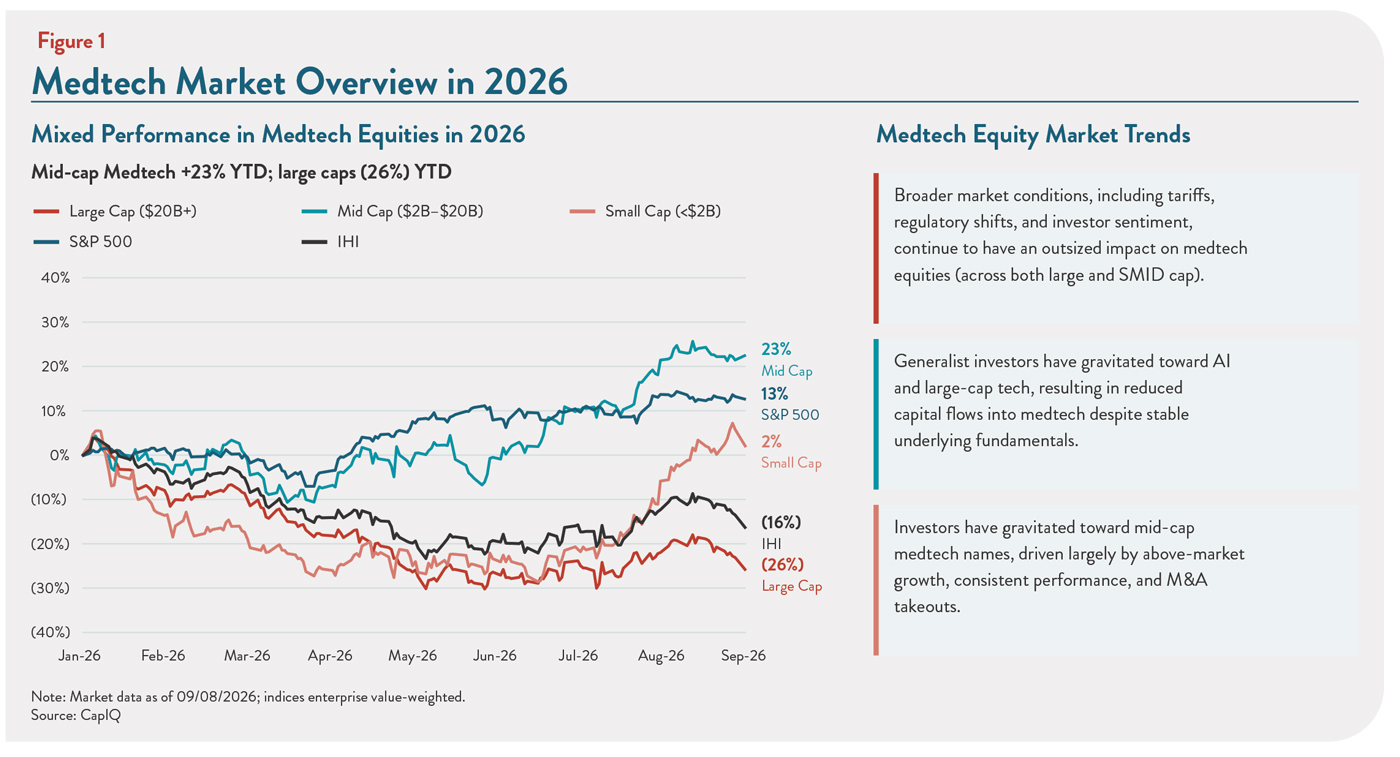
As of this summer, the tables may be turning, albeit modestly. From July 15, after Johnson & Johnson reported its second-quarter earnings, the IHI index of high-growth medtech stocks, which underperformed the S&P 500 isproportionately compared to other healthcare sectors, has been stabilizing, however, with medtech trading at about a 4% premium to its P/E as of late August. That’s much lower than its historic average but up from its 14% discount performance off the S&P a year ago (see Figure 1).
Some investors are coming back into medtech as a hedge against overweighting on tech. “I am calling on companies and telling boards that if they had a great 2026, they should start having real conversations about diversification while their portfolios are strong,” says Thom Busby, co-head of life sciences investment banking at Mirus Capital Advisors, adding, “Medtech is the busiest part of our life sciences practice right now, and it’s almost entirely M&A. You’ve got buyers who’ve been given the green light to do deals, and you’ve got boards that are finally aligned on realistic valuations.”
Says Pete Cataldo, head of medtech investment banking at Truist Securities, “We’re seeing much more interest in orthopedics this year … These are large, mature markets … The pure‑play public companies in the space have attractive valuations and… there’s more actionable opportunities.”

A Push to Invest in Innovation-Focused M&A
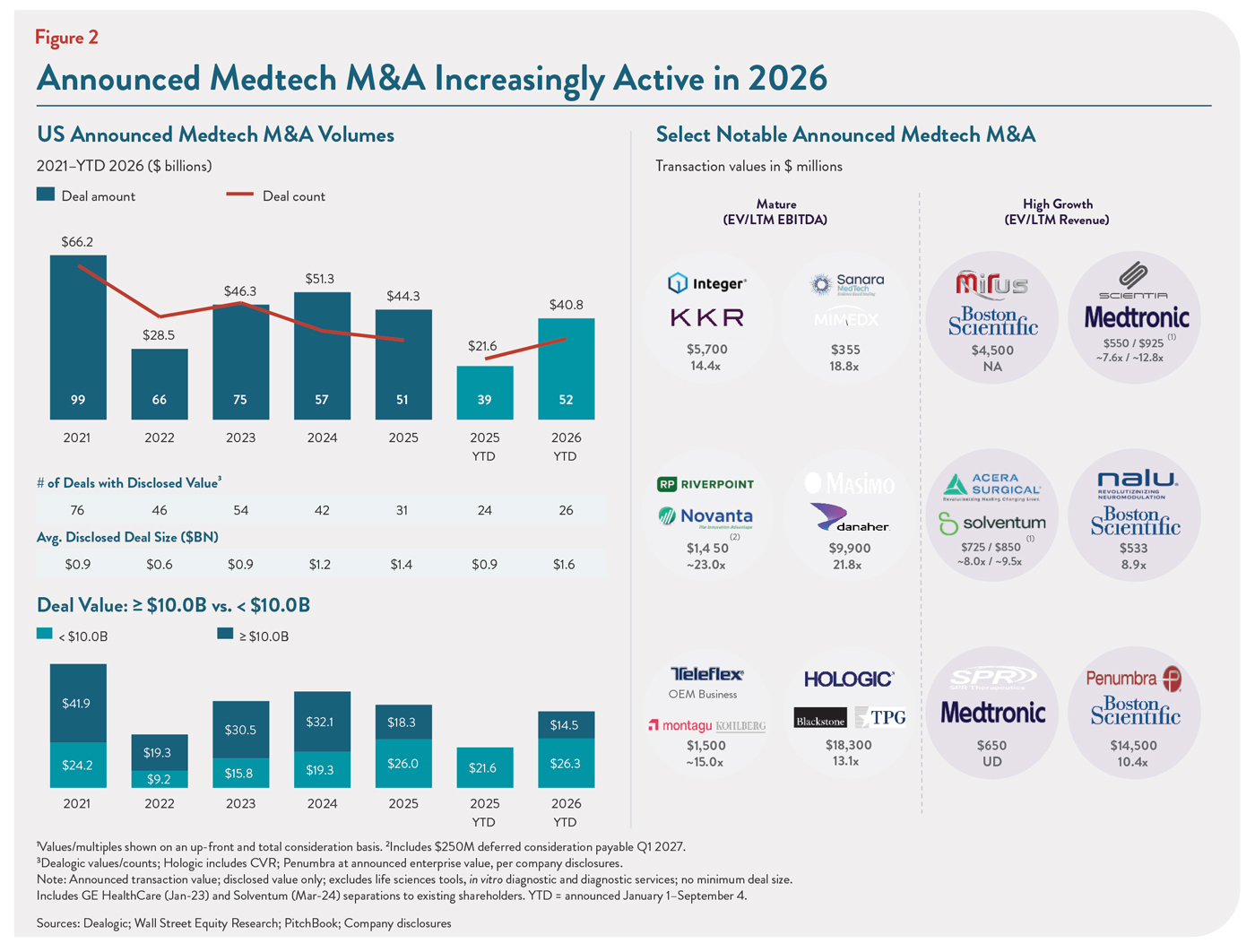
Contrary to the stock market, medtech M&A has been vibrant throughout 2026, driven by strategic and private-equity buyers’ financing needs and drive to accelerate innovation, more realistic valuation expectations by both sellers and buyers, and available public-market capital (see Figure 2).
Buyers are prioritizing innovators that are demonstrating commercial success, short-cycle clinical adoption rates, and clear pathways to market access. Biologics, visualization, neuromodulation, imaging, and selected technology-enabled products are areas with technologies of interest, more so than commoditized hardware.
Activists (Elliott Management at Medtronic, Politan Capital at Masimo) have indicated that failing to deploy capital smartly into technology-embracing deals can make companies targets, and bad deals can cost CEOs their jobs, says Busby. The warning shot, perhaps, was Elliott’s acquisition of a large stake in Medtronic, announced in August 2025.
Since then, Medtronic closed at least three acquisitions and took a stake in several more companies, all offering new technologies that strengthen its existing portfolio; Wall Street greeted its latest deals, both announced September 1, with enthusiasm, although the stock has continued to trade in a modest range, which analysts believe undervalues it. The company is making a $700 million investment in Hong Kong-based Cornerstone Robotics in exchange for exclusive distribution in select ex-US markets of Cornerstone’s soft-tissue robotic platform, Sentire. It is also investing up to $80 million in Pi-Cardia, which is developing a complex TAVR device for structural heart disease.
Sentire’s closed-console, boom-based configuration is distinct from the foundation of Medtronic’s robotics portfolio, Hugo, which has an open console, modular architecture, and more closely resembles Intuitive Surgical’s breakthrough da Vinci systems. Sentire will “improve Medtronic’s ability to address different surgeon preferences, hospital needs, and markets,” wrote Wells Fargo analyst Larry Biegelsen in a note, adding that he sees Medtronic’s recent growth acceleration as “durable and supported by the depth and breadth of innovation across its businesses.” He cited management as saying that given this growth, Medtronic’s payor mix, which is two-thirds Medicare, and its highly acute procedure mix, the company has minimal exposure to cutbacks in Medicaid and ACA subsidies.
Boston Scientific is under different kinds of revenue challenges, most notably related to declining demand for one of its most important products, the Watchman device for percutaneous treatment of nonvalvular atrial fibrillation, and competitive pressures in the US electrophysiology market, which accounts for nearly 17% of its total sales. In January it completed the purchase of the pain management company Nalu, a leader in neuromodulation, for $600 million, at a 10x multiple of revenues that Wall Street viewed as encouraging. That figure wasn’t an outlier, says Cataldo, noting that “strategics are willing to pay a premium for a high-growth, highly differentiated business. We've seen the high-growth valuations improve, but strategic buyers have proven that they’re willing to pay higher multiples for those same businesses. So, it is the decision point and the trade-off that boards are always thinking--about whether to sell or go public. And right now, it's favoring M&A versus IPO.”

In total, between January 2026 and August 31, 29 M&A medtech deals closed, with orthopedic transactions focused primarily on filling product gaps, according to Ryan Zimmerman, a managing director and senior medical devices equity analyst at BTIG. That tally does not include proposed deals, such as Stryker’s agreement to buy ZuriMED, a rotator cuff repair innovator, announced August 31, or Enovis’ purchase of eCential Robotics, a French robotics manufacturer, announced September 1. In full-year 2025, in contrast, 28 deals were completed, Zimmerman continues, adding that orthopedic M&A addressed portfolio gaps in robotics, peripheral nerve therapies, and shoulder repair.
The ZuriMED deal is typical of today’s M&A market. Terms were not disclosed, but ZuriMED has demonstrated that it has an effective commercial strategy for its FiberLocker System for rotator-cuff repair reinforcement, which it launched on a limited basis in the US in early 2025, says Busby. What's most valuable to strategics right now, he adds, are the sales cycle and physician adoption metrics. Strategics will pay a premium for companies with evidence that their innovative devices are being adopted beyond the top academic medical centers by the average surgeon in a non-flagship hospital.
Likewise, PE investors are also getting more active and playing the market from both sides. On one hand, they are looking to offload portfolio companies of funds reaching the end of their lives. (See the online video interview, "First Financings, Later-Stage Volume Robust, but Where Are Exits and PMAs?"available at MyStrategist.com.)
Many mid-market spine and orthopedics companies are owned by PE firms, which are attracted by the ability to leverage manufacturers’ hard assets, while using cash flows from their businesses to cover the costs of R&D. These companies need adequate growth capital to move quickly, as being first to market with a new medical device is a strong competitive advantage in an industry where the window for differentiation closes rapidly, Busby says.
Why Enovis Is Buying eCential Robotics
Start-ups and strategics, such as Canary Medical and Enovis, are betting that the disruptive innovation they embrace will outrun financing pressures and reimbursement cuts, leaving the industry overall healthier—or at least a strong player on Wall Street and among its customer base..
Enovis’ proposed acquisition of French surgical robotics company eCential Robotics exemplifies the kind of tuck-in deal that is critical to orthopedic growth strategies. The company is paying €176 million, plus up to €35 million contingent upon regulatory and commercial milestones, for a platform that has been validated commercially, most notably through a collaboration with Johnson & Johnson’s DePuy Synthesis orthopedics subsidiary.
Through a series of more than 20 roll-ups, Enovis has established a position as a mid-sized global player in an industry where four large competitors control roughly 80% of the market. (See “Flexing Its M&A Muscle, Enovis Builds an Ortho Recon Global Player,” MedTech Strategist, December 19, 2023.) It is particularly strong in knee and shoulder recon surgeries, and over the years has built an ecosystem that connects its enabling technologies, which it has named Astra. Astra currently has navigation capabilities, including AstraArvis, an augmented reality navigation system currently indicated for shoulder procedures.
The eCential robots will be included in Astra. Until now, however, robotics has been a glaring gap in Enovis’ portfolio, as it cautiously scanned the competitive landscape for a differentiated and validated platform. It moved to acquire eCential after a year-long co-development partnership around knee and shoulder systems convinced both sides they could best benefit from each other as one company.
ECential, which was founded by Stéphane Lavallée in2009, brings to Enovis a proven track record of commercializing multiple robotic platforms, a seven degrees of freedom arm suited to tissue‑sparing and complex approaches, proprietary robot control software and intellectual property, and an established manufacturing and regulatory base located in Grenoble, which currently produces about 70 robots a year.
By acquiring the company rather than partnering with it, Enovis gains full control of the supply chain and cost structure—acritical strategy as robotics pricing pressure intensifies and systems are increasingly bundled with implants, says Louie Vogt, group president, reconstructive. ECential’s engineering team will be folded into its broader Astra ecosystem, and eCential CEO Clément Vidal will become Enovis’ SVP, R&D, enabling technologies. The goal is to build an internal “robotic center of excellence” that lets Enovis control its own destiny in shoulder and knee robotics and adapt as the market, technology, and economics evolve, says Vogt.
Orthopedics is moving “beyond the implant” toward a data- and AI-driven model in which the real differentiator is how surgeons plan, guide, and execute procedures for each individual patient, he continues. Today’s robots, Vogt says, have largely made surgeons more accurate at hitting their chosen targets, but outcomes have plateaued because “we don’t know what the right target is” for a given patient’s anatomy and biomechanics—especially in the knee, which is far more complex than the hip.
The next frontier uses large clinical data sets and AI to learn ideal implant positioning and soft-tissue balance for different patient phenotypes, then uses technology—navigation, robotics, and eventually “robotically enabled implants”—to consistently execute those personalized plans, he continues. Over time, the technological advances will be smaller, tissue-sparing procedures and implant designs that would be impractical or impossible to implant without robotic assistance.
The development timetable is estimated to be two years for launching a next-generation knee robot followed by a robotic shoulder application, likely a year later. The requirements for successful product features, performance, and design are well understood for knee robotics, where some estimate that robotic penetration in the US is already approaching 30% of knee recon procedures. But in shoulder surgery, where Enovis has a significant market share, the first robotic platforms are just now being commercialized, leaving room for uncertainty—and opportunities.
eCential has partnerships for use of its robotic technologies in spine surgery with several companies, of which J&J’s DePuy Synthes is the largest. J&J’s VELYS Active Robotic-Assisted System incorporates eCential’s navigation, robotics, imaging, and surgical-planning technologies, while DePuy Synthes contributed its spine-implant portfolio, clinical/commercial expertise, and global route to market. DePuy launched the system in 2024, and the collaboration won’t be affected by the deal. (See “Surgical Navigation Penetration in Neuro and Spine: Claims Analysis and Implications for Industry,” MedTech Strategist, January 25, 2024.) Enovis has no plans to enter the spine surgery market, Vogt says.
A Reimbursement Policy Shift Leads to a Financing Opportunity
For Canary Medical, the mandatory, nationwide CJR-X value-based reimbursement scheme that CMS finalized in late July 2026 for lower-extremity joint replacement is “the biggest break we’ve received since I started the company [in 2012],” says Bill Hunter, MD, founder, CEO, and chief medical officer. That’s because “if they [CMS] go to a 90-day episode of care, providers will need to follow their patients and we are the only ones who can help do that.”

Canary is using the moment to initiate a $40 million to $60 million mezzanine financing—its first since 2021. The cost of building the company’s current data platform, which collects, stores, and manages data collected from the patient sensors, was hundreds of millions of dollars, so money raised from the current round would be used for building out its portfolio between now and 2028, when CRJ-X goes into effect.
Canary says it is the first of its kind in MSK to precisely quantify what until now have been fairly subjective, vague benchmarks that physicians use to assess patients’ clinical progress postsurgery. The company’s founders chose to focus on knee implants because those were the smallest implants its original sensor could be put into at the time. Its platform consists of an implantable sensor that collects patient-specific data, which generates several biomarkers that Canary’s data shows can be correlated to patient recoveries and help to identify which patients are going to recover faster and which will need more interventions to recover.
The data enables providers to intervene with unprecedented speed to reduce complications, which may improve results of surgery, while reducing costs for the healthcare system, says Hunter. Studies involving multiple specialties show that monitored patients do better than unmonitored patients, he continues, and doctors are taught early in medical school to mobilize patients after surgery to reduce the risk of blood clots, for example, but the question has been how much mobility is enough.
Hospital Capex Remains Stable, Despite Reimbursement Headwinds—for Now
Analysts are closely tracking healthcare system capital expenditures and procedure volumes. Publicly traded hospitals and orthopedics strategics, in their second-quarter earnings calls, by and large reported that “capital spending is in line or better than expected,” says Truist Securities’ Richard Newitter. A semi-annual survey Truist sent to 50 healthcare system administrators earlier this summer (published in July) offered a slightly more cautious sentiment, but no draconian drops in budgets and steady near-term spending.

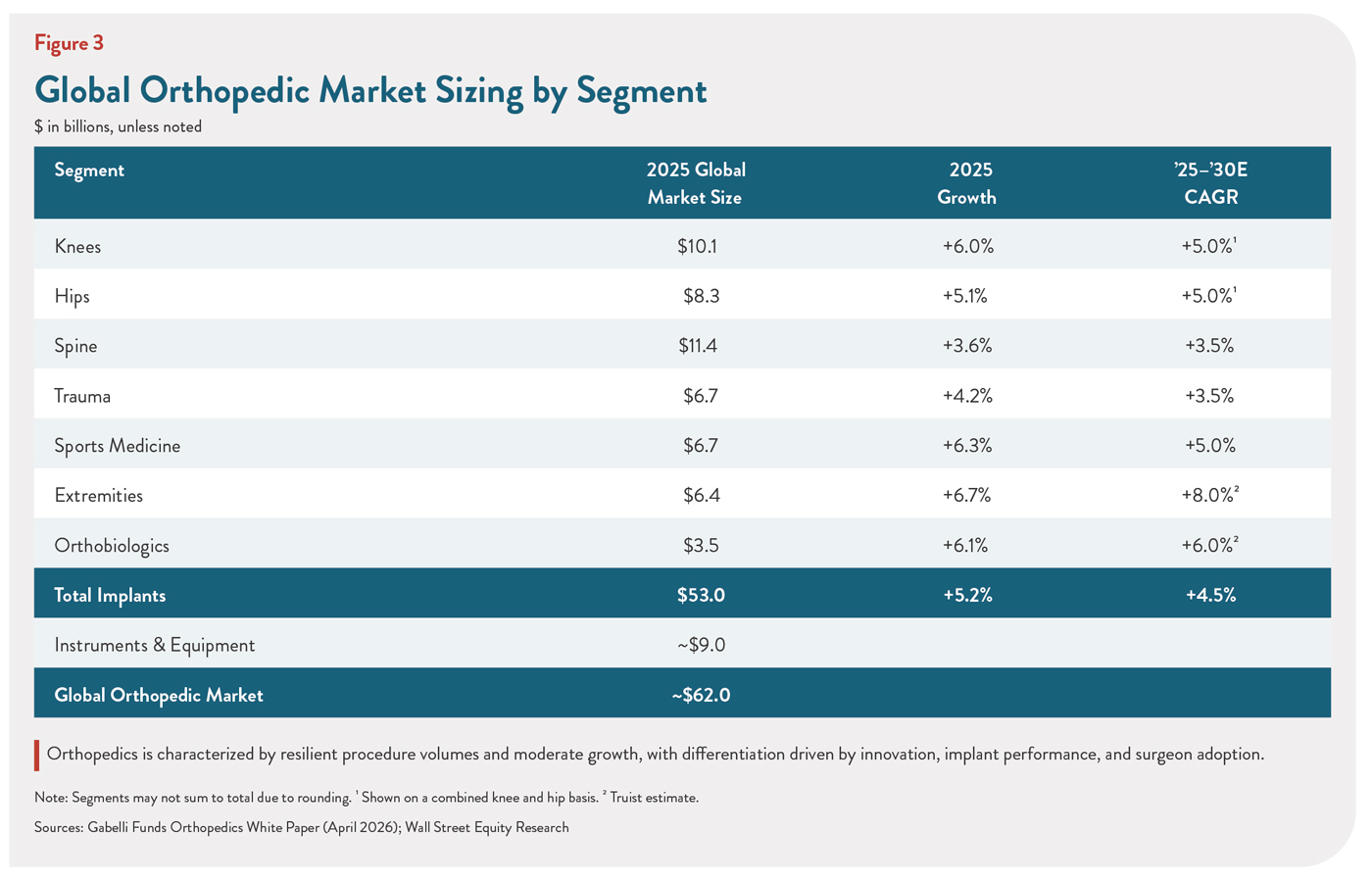
Even if capex slows in the future, revenue-generating equipment that attracts profitable procedures, such as orthopedic robotic systems, and differentiates providers in a competitive landscape will be more insulated from macro risks than routine purchases, Newitter continues. Players like Stryker, which has been gaining share in the highly competitive knee arthroplasty market for years, due in part to the success of the MAKO robotic system, are likely to continue to do so. Stryker is clearly taking share from market leader Zimmer Biomet, and while diverse factors account for those dynamics, including Zimmer’s US commercial strategy restructuring, Stryker’s headstart in robotics is the most significant factor (see Figure 3).
Interest in spine robotics, in contrast, has moderated as surgeons believe the value proposition of current technologies is limited.
Top risks to hospital budgets are inflation, reimbursement cuts, and supply costs, according to the survey. On a quarterly basis, administrators’ priorities remained generally stable, although within robotic allocations hip and knee robotics slipped slightly in priority.
Utilization is growing slightly across all care settings, although at a slower pace than in the past. Whether this slowdown is normalization following atypical post-COVID catch-up trends or the results of pending government reimbursement cuts remains to be seen. Hips, knees, cardiac surgery, hernia repair, and interventional cardiology all saw below normal utilization growth, compared to earlier this year.
Concerns about risks related to government reimbursement, followed by physician relationships, and delays in supply chains decreased since the previous survey, published in early 2026.
“The sky is not falling,” agrees Ryan Zimmerman of Bank of America/ BTIG. There is worry going into the midterms, although if Dems win control of Congress, Wall Street assumes medtech will do well. If the outcome of the election favors Republicans, manufacturers will hold the line, with the biggest impact from new laws taking effect in 2027 and later. Both hospitals and ASCs face tighter economics, leaving them to push back against premium implant pricing and to be more open to good enough mid-tier implants with acceptable outcomes.
Robots are now “table stakes” in large joint recon surgeries, but large chassis robots are economically challenging for many ASCs, leaving room for the introduction of handheld, lower footprint systems, Zimmerman says. These systems are important for pull-through sales of implants and collecting data that helps track outcomes, which will be important as new CMS-mandated CJR-X (Comprehensive Care for Joint Replacement expanded) requirements take effect in 2028.
As Budgets Tighten, Hospitals Prioritize Revenue-Generating, Differentiated Capex
On a call in late August with BTIG, Martin Marshall, the chief operating officer at UT Southwestern Medical Center (UTSMC), gave an example of these dynamics, providing metrics about a specific healthcare system in a region with a rapidly growing population. Marshall, who has responsibility fora $314 million budget, has worked extensively in hospital and clinical support operations and supply chain management.
UTSMC procedure volumes are up approximately 8-11%, with transplant, cardiovascular and urology among the strongest service lines, he said. As a result, Marshall estimates 2027 procedure volumes will incrase in the mid-to-high single digits, although that number might shift based on ACA exchange changes and uninsured rates. Elective and orthopedic procedures are the most vulnerable to payor-related delays, while transplant and spine surgeries are less deferrable.
The capex budget remains close to 1% of the system’s annual revenues, or about $100 million, Marshall said, but the funds are increasingly allocated centrally and more selectively toward revenue-generating projects. Spending priorities include MRI, CT, C-arms, hybrid ORs, and replacing aging da Vinci robots and surgical beds. Pharmacy automation is also a priority, with BD’s Pyxis medication management platform favored for its interoperability with Epic electronic medical records and Alaris pumps.
He predicts 2027 procedure volumes will have slightly slower growth, due to reimbursement pressures and government policies. To manage demand, operating rooms have been added, which the heatlhcare system runs 24/7. It has also added ASCs, although those are not open 24/7.