ARTICLE SUMMARY:
With their newly proposed RAPID pathway, FDA and CMS say companies can work with them to design a pivotal trial that will address regulatory authorization and national Medicare coverage. Stanford’s Josh Makower and TCET architect Steve Farmer debate if that is doable.
Can a company’s pivotal trial designed to win FDA authorization also check the necessary boxes to support national Medicare coverage? With the recent proposal for the RAPID (Regulatory Alignment for Predictable and Immediate Device) coverage pathway for FDA-designated Breakthrough Devices, CMS and FDA officials are signaling that they believe the answer is “yes.”
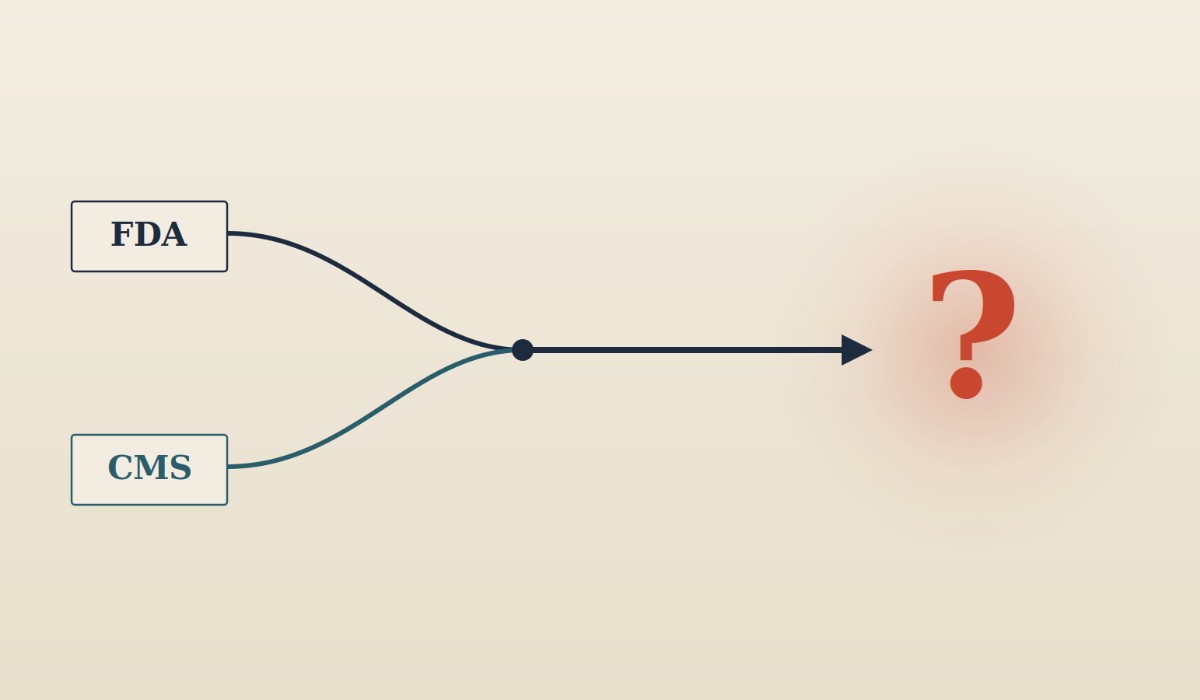
The agencies are selling RAPID as a mechanism to align manufacturers, FDA, and CMS during early planning of the pivotal trial for Breakthrough Devices so the outcomes can support approval and proposed national coverage on the same day. (See “FDA and CMS Promise RAPID Coverage, But Industry Needs More Details,”Market Pathways, April 24, 2026.) They present it as a replacement for the recently launched Transitional Coverage for Emerging Technologies (TCET) pathway, which is designed to bring the parties together about 18 months before anticipated approval—when the pivotal trial is typically well underway—for up to five devices per year, to identify data gaps and with the aim of establishing a coverage with evidence development (CED) policy within six months after authorization.
Steve Farmer, MD, who until last year was chief strategy officer for coverage at CMS where he was the principal architect of TCET, is skeptical about the promise of RAPID. Farmer, who is now co-owner and senior partner of ABiG Health, argues there are important practical considerations to how pivotal studies are designed for high-risk devices, and regarding CMS and stakeholder resources, that led his team to design TCET as the preferred model.
Josh Makower, MD, co-founder and director of the Stanford Mussallem Center for Biodesign, serial medtech entrepreneur and investor, and vocal proponent of policies to expedite coverage of innovative devices, on the other hand, is optimistic that RAPID will be a success. There is no reason FDA pivotal trials that include enrollment and protocol features informed by CMS shouldn’t go a long way toward meeting the Medicare “reasonable and necessary” standard, he contends.
The two debated the point during a short exchange that arose as part of a broader panel discussion on the necessity of early reimbursement planning for medtech companies moderated by Market Pathways April 28 at the MedTech Strategist Innovation Summit in Dublin. Here’s what they had to say (with light editing for clarity).

Market Pathways: With the RAPID program, one detail seems to be that it’s intended to bring the parties together early-stage when they're just planning a pivotal trial. TCET I think is more about, the pivotal trials are already underway, but now we're bringing everybody together to see what evidence needs there are and where the gaps are. Is that the right distinction to make? Is it too big of an ask, early on, to do the FDA pivotal trial to meet all the needs for the different stakeholders, including CMS?
Josh Makower: It depends. I think both parties, CMS and FDA, need to follow some sort of reasonableness standard. I think if we can approach it that way, to require Medicare beneficiaries in the trial, that seems reasonable. A nominal amount to achieve statistical significance would be reasonable. One of the greatest things that could come of this, if it is detailed as such, is for a trial to be outlined up front, which would, if successful, establish the framework for reasonable and necessary. That would be groundbreaking. Do you think so, Steve? What do you think?
Steve Farmer: I think it's unlikely that you're going to conduct a single pivotal trial that actually satisfies a reasonable and necessary standard, at least for high-risk devices, because of the way that pivotal trials are designed. They're typically designed to identify the ideal patient who is likely to show the benefits of a technology, which very, very frequently is not representative of the patients who are the intended users of the technology.
There are heart failure trials with 80% men, for example. They don't exclude women, but they're 80% men. Then you intend to use the technology in women with heart failure, and you may encounter circumstances in real-world use where you get very different performance characteristics than you did in the pivotal. It’s a very reasonable expectation that, before you roll out technologies to the entire Medicare population, you have evidence of benefit.
For example, with transcatheter valves, there is evidence that sizing really matters for the valve hemodynamics and that the devices that were studied in men initially didn't perform the same in women, who are likely to be smaller, and that alters the procedural risks and hemodynamics of the valve.
Makower: But if you, up front, identify that at least a certain percentage of the population needs to be in whatever categories that are relevant for the device, you should be able to do a trial that you can establish as reasonable and necessary, right?
Farmer: Potentially, if there are sufficient numbers in the pivotal. But many device trials are relatively small. So if you talk about a trial in a pivotal that has 200 patients, and then less than half of them are Medicare beneficiaries, and then a small fraction of those represent various different subgroups, your likelihood of getting adequate statistical sampling of those subgroups is low, which is not to say that you need to conduct full-blown trials in the postmarket, but I certainly think there's a role for RWD [real-world data] in demonstrating generalizability to a broader population postmarket.
Makower: The question is, “What will be the trigger for coverage, even in a CED [coverage with evidence development] environment?” It certainly would be great if a trial could be designed—this is what I think RAPID is, but details are missing—where you would design what would be necessary for safety and efficacy, and what would be necessary for coverage with further follow-on real-world evidence development in the postmarket world. That would be fantastic if that's real. That feels to me reasonable and also very effective for stimulating innovation. Let's lay down a clear trial that would allow for innovators to execute and deliver on results. If it's successful, you get your FDA approval, you get coverage, at least for some period of time during which you collect additional real-world evidence.
Farmer: That’s TCET. Basically, that's the framing of it. The challenge with TCET was that we're talking about devices here. And devices can range from diagnostic lab tests to AI to high-risk implantable devices like TAVR. And we're lumping those all together as if they're the same, with the same requirements. And I don't think that that's true at all. TCET was designed for high-risk interventions, not for diagnostic lab tests, not for lower-risk wearables or Class II devices. To the extent that RAPID extends that vision of premarket CMS engagement and provides greater access to a broader range of technologies that are truly beneficial in the context of robust evidence generation, I think that is productive.
Makower: Correct me if I'm wrong, but I think in TCET, you really were not able to engage even to be considered for TCET until you were approaching your approval. You weren’t really doing this at the IDE stage … which means you've already placed your bet on a trial design, right?
Farmer: That’s fair. It was a hard limitation of staffing. I would note that the idea that you're going to engage with companies at the TAP phase, pre-development of your pivotal, requires an enormous investment in companies that are never going to make it to market. If you have very constrained resources, that is not how you're going to deploy them. My understanding is that the concept of this new approach is to put a lot more resources into it earlier on.
Moving Beyond Parallel Review?
In practice, there are still many more details to come about how RAPID will work. The agencies have promised to publish a Federal Register notice laying out their vision, and to provide a 60-day period to collect public feedback on the proposal.
Later in the conversation in Dublin, we asked the panelists about lessons that might be learned from an existing program that has at least some superficial similarities to RAPID, FDA-CMS Parallel Review. That pathway, first launched in 2011, also offers early-stage interaction with the two agencies and a promise of aligned FDA authorization and national coverage, but it has shown limited success with 97 requests from companies to participate resulting in only two coverage determinations.
Farmer argued that the promise of a proposed national coverage decision on the day of FDA authority doesn’t offer the sufficient time for the in-depth stakeholder engagement that is necessary to deploy practice-changing innovations. “If you have a very complex technology like TAVR, which requires extensive stakeholder engagement and facility investments to hire the right staff, the right equipment, and engage the right teams to deploy the technology, you really need to get input from a lot of parties to construct a viable policy,” he explained. “The Parallel Review process promises a proposed decision on day one, which does not allow for that substantive engagement, which is essential for adoption of true breakthrough technologies that really change a paradigm of delivery.”
Makower pointed out that the Parallel Review Program lacked the backing of sufficient CMS resources. He argues that Congress should pass legislation to ensure accelerated coverage for breakthroughs is codified in legislation to provide certainty for all stakeholders. “I think with those elements,” he said, “it does have a chance to be really impactful.”
[Photo: MedTech Strategist Innovation Summit]