
ARTICLE SUMMARY:
Pulsed field ablation is set to supplant radiofrequency and cryoablation as the preferred catheter-based approach to stopping arrhythmias. Because it is safer and faster than older technologies, it is helping electrophysiologists treat more patients and accelerate the overall growth of the cardiac ablation business. Excerpted from our recent feature, "PFA Is Ready to Electrify the Electrophysiology Market."
Catheter-based cardiac ablation is a minimally invasive approach to treat cardiac arrythmias caused by aberrant electrical signals in the walls of the heart. Guided with increasingly sophisticated electroanatomic mapping and navigation systems, electrophysiologists carefully create lesions (dead cells) that block those signals. Focal ablation tools ablate one “dot” at a time to make lesion lines while multielectrode “single-shot” catheters produce multiple lesions simultaneously in a fixed pattern.
Melvin Scheinman, MD, first demonstrated catheter ablation in the early ’80s at the University of California, San Francisco using high-energy direct current shocks to ablate the atrioventricular nodal pathway prior to pacemaker implantation. The early ablation experiments led to the development of radiofrequency ablations devices that create precise lesions by heating the target tissue over 50 degrees Celsius.
In the late ’90s, a group led by Michelle Haissaguerre, MD, in Bordeaux, France, mapped the electrical currents that caused atrial fibrillation (AF) and found most of these signals could be blocked by ablating circumferential lesions inside the pulmonary vein—so-called pulmonary vein isolation (PVI) ablation. In 2009, Biosense Webster’s NaviStar ThermoCool and EZ Steer ThermoCool Nav were the first ablation catheters to earn FDA approval specifically to treat AF in patients for whom anti-arrhythmic drugs were insufficiently effective. In 2010, Medtronic introduced the Arctic Front cryoablation balloon catheter, which created lesions with extreme cold instead of heat.
Since then, the global electrophysiology market, driven largely by the AF indication, has grown to around $13 billion a year.
Despite the overwhelming success of AF ablation, it does carry risks. Heating or freezing cardiac tissue can cause collateral damage to the blood or nearby organs. For example, in 2023, the POTTER AF study showed ablation for atrial fibrillation with radiofrequency or cryoablation created an esophageal fistula in 0.025% of patients. Although rare, two-thirds of the patients who suffered this complication died from it.
 Boston Scientific projects PFA will account for about half of AF ablation procedures in 2026, growing to 80% by 2028 while also helping to expand the overall EP market from $13 billion to $20 billion.
PFA avoids those risks by precisely destroying target tissue with microsecond-duration, high-voltage electrical fields. The short pulses kill the cells by causing permanent electroporation—holes in the cell membranes. Pulsed fields have been tested to selectively disrupt tissue in other applications for about a century, but research on PFA catheter technologies specifically for cardiac arrythmias gained momentum in the early 2010s, not long after the first radiofrequency and cryoablation catheters appeared.
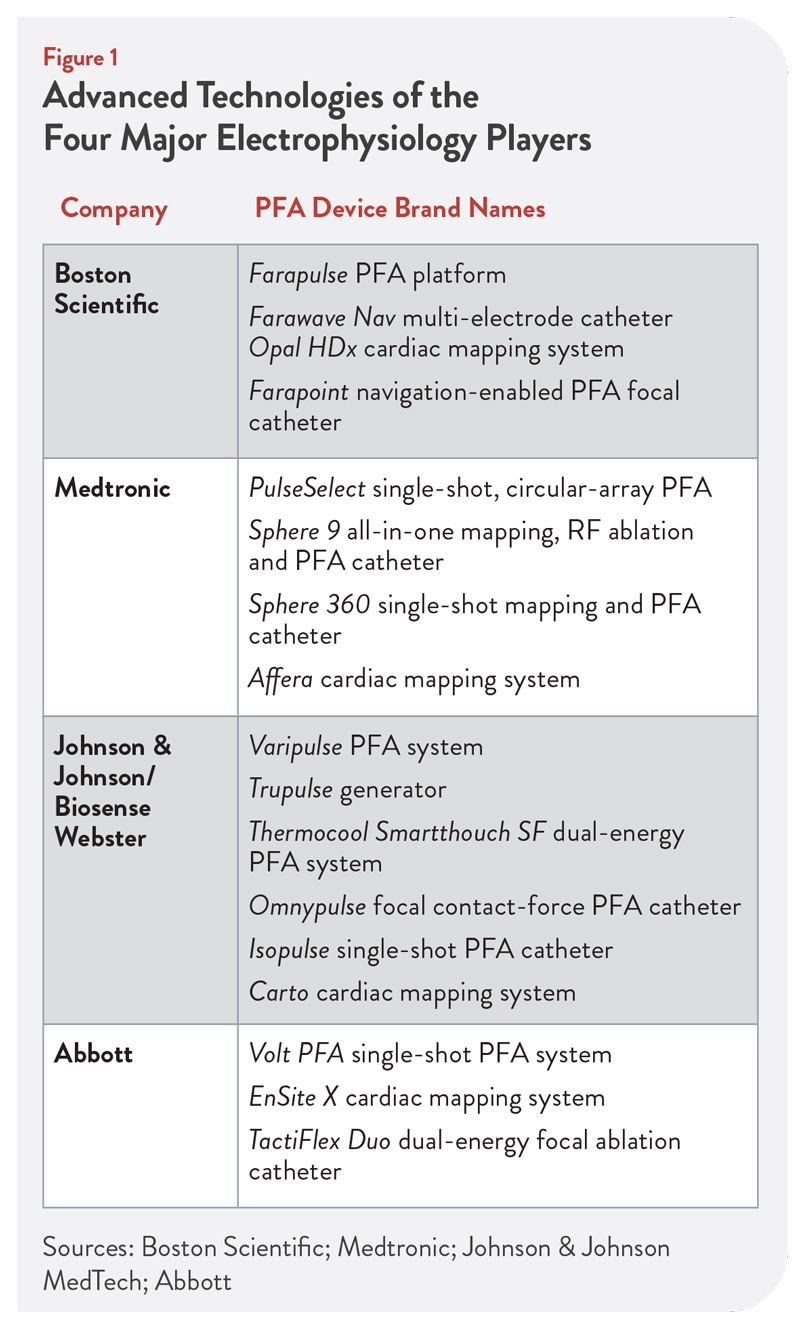
Since then, each of the four major electrophysiology players have advanced PFA technologies, first in Europe and then in the US (see Figure1). Three systems supported by major US competitors reached the US market in the first quarter of 2024 and the fourth just arrived in early 2026. These competitors are trying to take market share by emphasizing the unique features of their PFA technology and integrated mapping and navigation systems.
Continue reading here.