
ARTICLE SUMMARY:
The treatment of low back pain is beginning to move toward a more stratified, personalized model of care. Scientific and technological advances are creating opportunities for new entrants in the market. Excerpted from our recent feature article.
For decades, chronic low back pain (cLBP) has been worked up with blunt tools not tied to specific diagnoses—routine MRI, crude imaging biomarkers like Modic changes and disc height loss—and, in increasingly rare cases, invasive discography that many surgeons now shun—leaving clinicians guessing which patients, if any, will benefit from surgery, nerve ablation, or drugs. Incomplete information has resulted in subpar treatment of patients who are disappointed with their results and continue to experience sometimes disabling pain. cLBP has been cited as one of the underlying causes of the opioid epidemic in the US (see Figure 1).
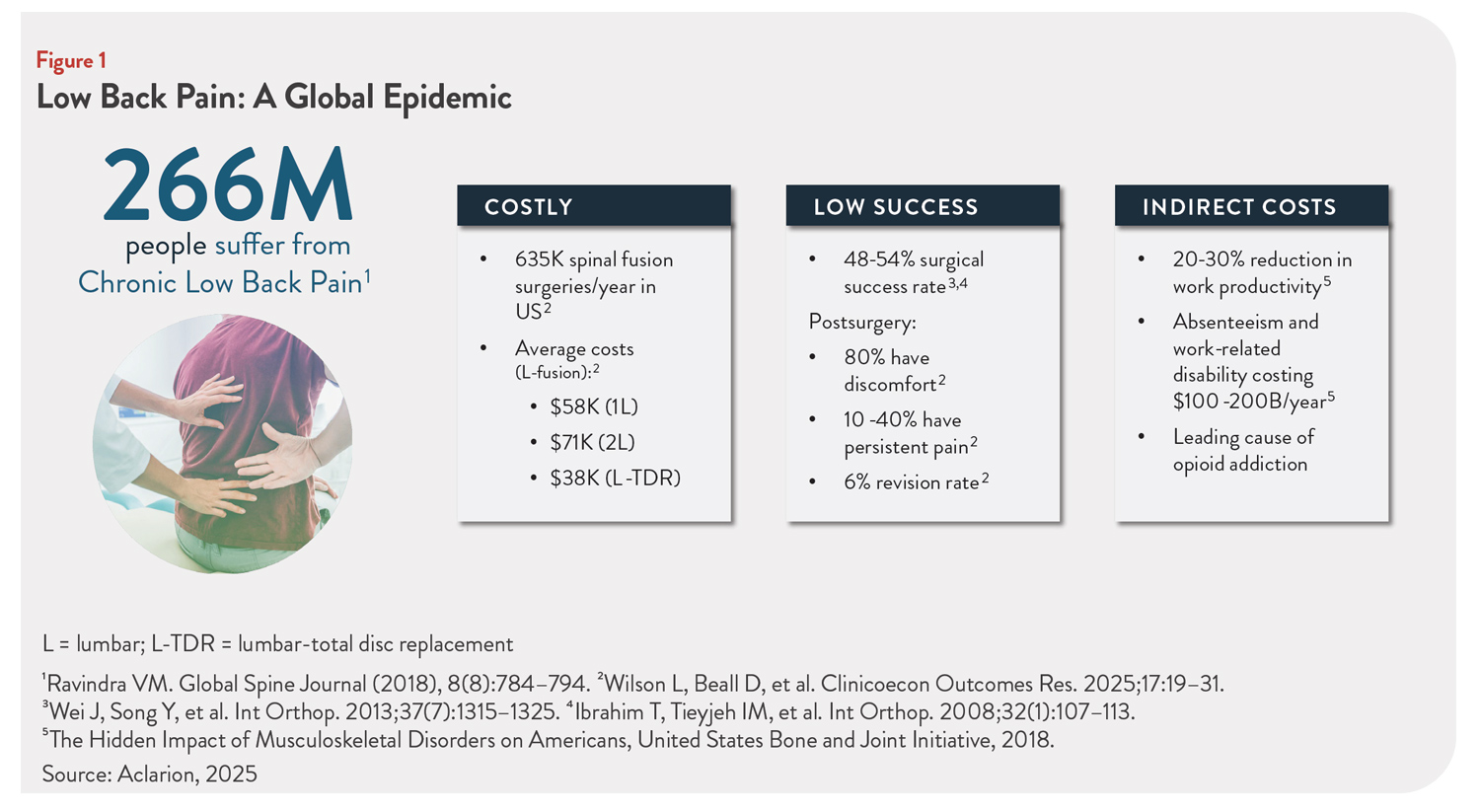 A wave of innovative technologies and expanding data sets is changing this equation and has the potential to upend patient care. Relievant, now part of Boston Scientific, is building a successful basivertebral nerve ablation (BVNA) business for patients whose diagnosis via MRI correlates with very specific vertebral endplate and adjacent bone marrow changes, known as Modic 1 and 2 types.
Persica Pharmaceuticals is testing an intradiscal antibiotic hydrogel therapy aimed at a subset of cLBP patients who present with discogenic pain related to an infection inside the disc. Aclarion’s Nociscan clinical decision-support platform combines magnetic resonance spectroscopy (MRS) and proprietary biomarkers to create a noninvasive “virtual discogram.” Further downstream, the National Institutes of Health (NIH) BACPAC/HEAL Initiative, the largest federally funded effort of its kind, has spent eight years collecting the most comprehensive dataset ever assembled from patients with cLBP and is now using that data to conduct basic research on its biological, physiological, and behavioral causes.
These efforts reflect demand for a more nuanced approach to back pain, in which an individual’s condition can be correlated closely to the proper treatment, based on multimodal, quantitative measures.
A special issue of the International Journal of Spine Surgery (IJSS), published in December 2025, focusing on the need for precision in pain management, was noteworthy for its underlying message: the field is at an inflection point. The editors argue that by treating pain holistically as a complex neurobiological, psychological, and existential condition, they can improve patient outcomes. A key enabler of that vision is better diagnostics that can accurately identify subtypes of pain based on underlying biology combined with structural information.
“Spine surgeons, by training, address mechanical lesions. They decompress, stabilize, and fuse while attempting to preserve motion. Pain interventionalists apply ablative or neuromodulatory techniques to interrupt nociceptive signaling. Psychiatrists often encounter pain as a comorbidity, intertwined with depression or trauma. Patients, for their part, present with something messier—an aching, immobile body layered with loss, fear, dependence, and often despair,” wrote IJSS guest editor Morgan Lorio, MD, FACS, a spine surgeon who is past president of the International Society for the Advancement of Spine Surgery (ISASS), which publishes the journal, and chair emeritus of the association’s coding and reimbursement task force.
The rethink currently is not high on the radar of most spine surgery companies, which are reluctant to deploy significant assets into early-stage biological research and are focused on their immediate goals in an extremely competitive environment: driving sales of their implants and enabling technologies, for example, robotics and navigation tools. However, it is proving to be an opportunity for new players, such as Boston Scientific, which are bifurcating the spine surgery business by embracing less-invasive procedures that can be performed at lower cost by interventional pain specialists and that can be correlated to specific types of pain.
Boston Scientific’s purchase of Relievant in 2023, for $850 million plus significant milestones, is one example. Its successful commercialization of Relievant’s Intracept Intraosseous Nerve Ablation System underscores the value of a clear-cut diagnosis for treatment of a particular type of cLBP, backed by solid evidence of impact on outcomes—something that is usually not available for the condition. The procedure’s sales growth, from roughly $70 million at the time of the purchase to an estimated $200 million in 2025, confirms this strategy as well as the reasons for Boston Scientific’s interest in interventional spine, which began about 2019. (
Stryker, too, is building a position in interventional spine, even as it spun out its slow-growing traditional spine surgery business, which it sold to VB Spine in April 2025. Other companies benefiting from the surging interest in interventional spine are Mainstay Medical and SI-Bone.
Excerpted from Personalized Medicine is Coming to Chronic Low Back Pain. Continue reading here.