
ARTICLE SUMMARY:
Medtech investing has maintained its momentum from 2025 through 2026, according to PwC’s latest medtech deals outlook. Excerpted from our recent feature, “As Dollars Chase AI Dream, Investors Stay Grounded.”
The dependable returns that investors have come to expect from medtech are not always enough to attract investment in 2026, explains James Woods, PwC’s US medtech deals leader and one of the authors of the firm’s deals outlook. “Over the last couple of years, with the increased interest in and  acceleration of technology in the high-tech space around AI, those types of [high-technology] companies have been able to attract the growth capital that had previously been satisfied with the returns [from medtech],” he tells MedTech Strategist. “There has been a rotation of capital out of medtech and other growth stocks and concentration more into high tech, which has obviously very significantly impacted medtech returns [creating] a fairly significant headwind for longer-term innovation in the industry generally,” Woods says.
That “headwind” for company valuations will create opportunities for acquirers. “We remain bullish about the outlook for the medtech industry,” Woods says. “Obviously, the pullback in valuations that we've seen is going to make some acquisition targets more attainable than they were six months ago. [Deals that once] may have been challenging from a value creation perspective may now allow for value-creation opportunity through M&A.”
2025 Momentum Carries Into 2026
Despite geopolitical challenges, 2025 was a record year for mergers and acquisitions in medtech, and PwC sees that momentum continuing through 2026. The total medtech deal value for the first half of 2026 reached $36.5 billion (see Figure 1).

While private equity is looking for “accessible” opportunities, the big strategic companies are looking to acquire companies that “strengthen long-term defensible growth” in high-growth areas like cardiovascular, neurostimulation, and patient monitoring, 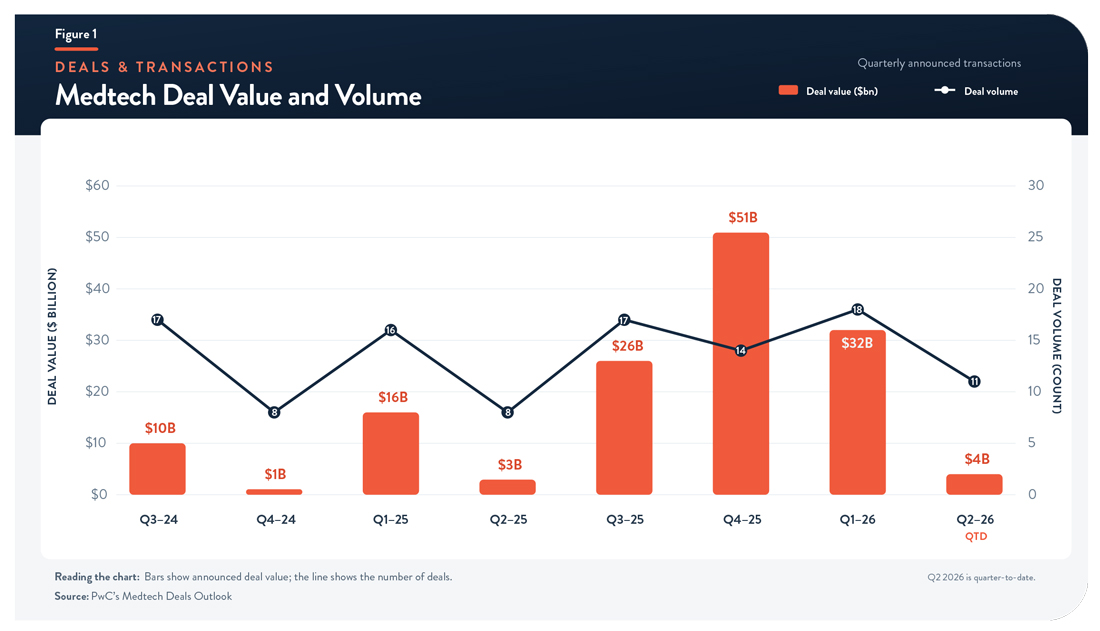 according to PwC. The top 10 list for the first five months of 2026 includes Boston Scientific’s $15.2 billion acquisition of Penumbra, Massimo’s $10.2 billion deal for Danaher, and three different deals by Medtronic totaling nearly $2 billion.
PwC also emphasizes strategic divestitures and “portfolio shaping” as a driver of medtech M&A activity. “The resulting divestitures and carve-outs are creating a deeper pipeline of opportunities for both strategic buyers and private equity,” PwC explains in its report. “At the same time, capital market pressure and lower equity valuations are creating openings for take-private transactions involving scaled platforms where private ownership may better support multiyear value creation.”
Depth Versus Breadth
Companies rely on small M&A deals and partnerships to build “ecosystems” of products and services that work together within health systems and across different sites of care. “The concept of category leadership continues to resonate within the industry,” Woods says.
However, established leadership in one particular area can only drive growth so far. “For these companies that have grown significantly larger over time, to maintain that high-growth rate, [they must] look into businesses of scale growing at the rates that they hope to achieve, and that's where we see this concept of adjacencies and an expansion into new business areas.”
For example, Stryker’s biggest and most well-known businesses are spine, orthopedics, and medical/surgical. Those businesses created an adjacent opportunity in neurovascular devices, which in turn led to an opportunity in vascular disease.
Attaining leadership in one sector may require giving up on another. “We've seen a lot of value creation [from companies that are] second and third to market, but you do get to a point—particularly in some more niche markets—where continuing to compete in that space may not be the highest value use of capital,” he says. “That’s where those divestiture activities often originate from.”
Creative Deals
To attract scarce capital, venture-backed companies often accept a longer transaction cycle than they once would have as investors are trying to de-risk their investments. But Woods also sees opportunities for innovative companies to attract buyers early in the innovation process. “In particular categories where there are disruptive innovation and scarce assets, you will see buyers look to move relatively quicker to secure that space and acquire the leading assets in a particular category,” he notes.
“We [also] see continued opportunities to do structured transactions, whether it's through earnouts or different types of structures that align those interests and help bridge the value gaps when there are those inflection points that are difficult to negotiate,” Woods says.
For example, in recent months, Medtronic entered a US distribution deal with Contego Medical with an option to eventually acquire the peripheral intervention technology company and Boston Scientific announced a $1.5 billion investment in MiRus with an option to acquire MiRus’ Siegel transcatheter aortic valve replacement system.
While the M&A deals may become more complex and take longer to complete, they will remain the only exit option for the vast majority of venture-backed companies, as the initial public offering market “continues to reopen inconsistently,” PwC explains in its report. Woods believes a few medtech companies with highly differentiated technologies may be able to “extend their runway to acquisition” with an IPO, but that approach will not be as common in medtech as it is in the biopharma or high-tech sectors.
Read full article here.